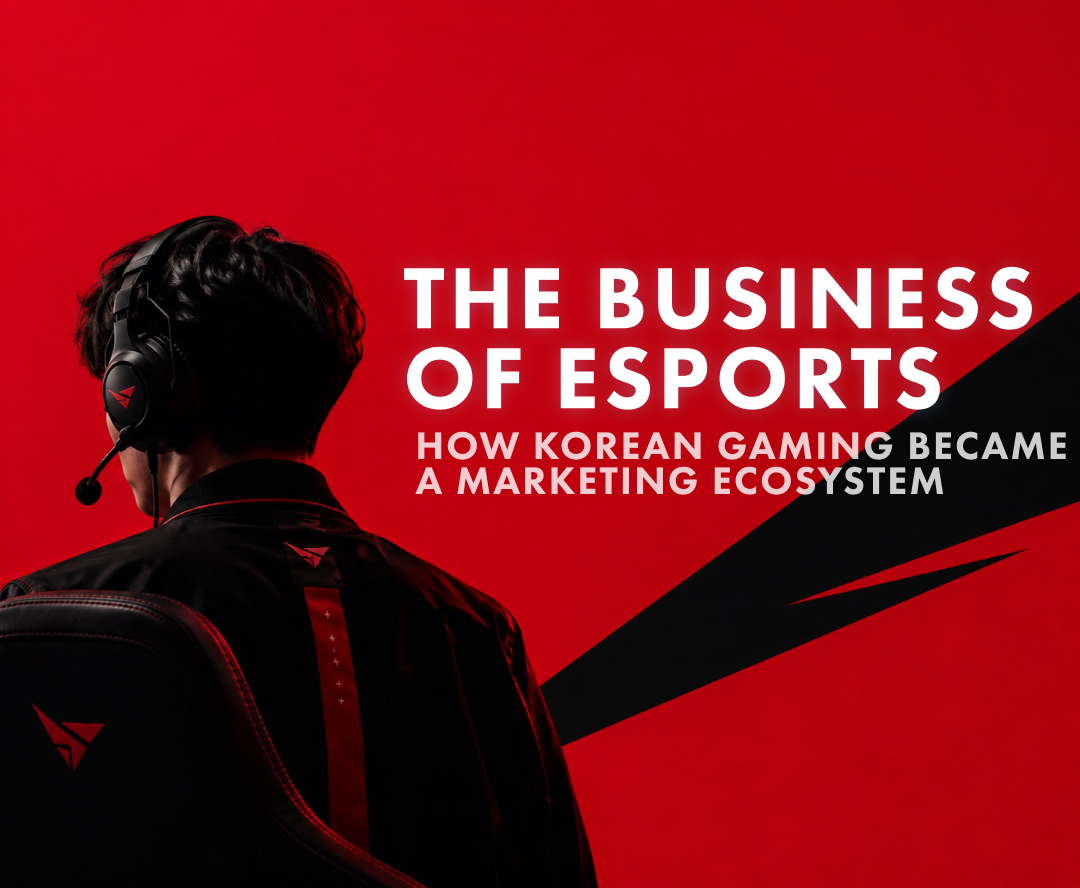
League of Legends is one of the most-watched video games in the world, and South Korea’s professional league for it, the LCK, is widely considered the toughest and most prestigious in the sport. T1 is the league’s most famous team, and Faker (real name Lee Sang-hyeok) is its star player, often called the greatest League of Legends player of all time.
What makes T1 interesting for marketers isn’t just that they win a lot. It’s that the team has turned itself into something closer to a full entertainment brand, complete with concerts, charity auctions, and record-breaking moments that make headlines outside the gaming world. And T1 is really just the most visible example of a much bigger story: Korea has built one of the most advanced esports markets on the planet, and that market runs on different rules depending on which game you’re looking at. Riot Games, which owns League of Legends, keeps a very tight grip on what brands are allowed to do inside its game. Other Korean-made games, like PUBG and KartRider, do the opposite and build entire in-game economies around brand collaborations.
T1 / Faker — the icon that structures the whole marketing ecosystem
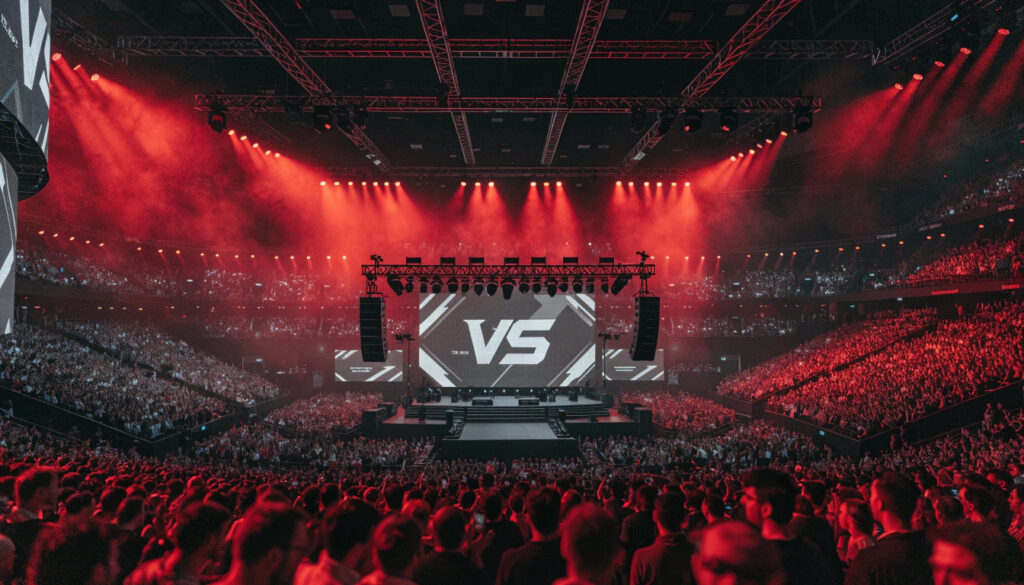
T1 doesn’t just play matches, it turns them into events. In April 2026, the team took over the Inspire Arena in Incheon (a large concert and events venue) for “2026 T1 Home Ground,” a three-day fan festival built around a handful of official league matches. Instead of just watching a game, fans got live K-pop performances, branded food stands, and interactive fan zones layered around the competition itself. The format was launched in 2024, and it lets T1 host its official matches outside its usual home venue, in much bigger spaces, leaning fully into the idea of playing in front of a “home crowd.” It’s already grown fast: the 2025 edition drew around 30,000 attendees combined, with ticket revenue estimated between $1.4 and $2 million. T1’s own leadership has said the long-term goal is to eventually host an event at the Sphere in Las Vegas and build a stadium of its own.
The clearest example of how far this “player as brand” idea goes was a charity auction held during the festival. A fan paid 2.52 million won (about $1,703) for a private coaching session with Faker, the highest bid of the night, with the money going to charity. This wasn’t a one-off stunt price. Other T1 players’ coaching sessions in the same auction sold for real money too, ranging from roughly $730 to $1,840, showing there’s a genuine market for one-on-one access to these players.
A month later, Faker showed up somewhere much less expected: a Google Play ad, cast opposite K-pop star Karina from aespa, with nothing to do with League of Legends at all. Released to coincide with Faker’s 30th birthday, the campaign was part of Google Play’s “Play on Play” series, and it deliberately avoided leaning on his competitive persona. The gamble paid off in reach: the teaser alone passed 1.58 million views within a week, pulling in Faker’s own fanbase, Karina’s K-pop fandom, and the general public all talking about the same campaign at once. That’s the clearest sign yet that Faker’s brand value has outgrown esports entirely: a global tech company, with no gaming angle to sell, chose him purely as a mainstream celebrity face.
The T1 story might suggest that Korean esports runs purely on charisma and spectacle, but that’s only part of the picture. Behind the concerts and record-breaking moments is a genuine, fast-growing industry, and understanding its shape helps explain why brands keep showing up.
The Korean esports market: a solid data business
Strip away the fan festivals and record-breaking milestones, and what’s left is a real advertising market with real numbers behind it. South Korea’s esports industry generated $170.7 million in revenue in 2024, growing at a compound annual rate of 7.3% between 2019 and 2024. Market researchers don’t all agree on exactly how fast that growth will continue, but the direction is consistent across the board: up, and driven overwhelmingly by one thing.
Sponsorship is by far the largest slice of that market, worth $104.2 million in 2024, or 61% of the entire industry’s value. In plain terms: three out of every five dollars spent in Korean esports isn’t going toward ticket sales, merchandise, or media rights. It’s going toward brands paying to be associated with teams, leagues, and players, exactly the kind of activity we just saw T1 turn into a full weekend festival.
That imbalance makes sense once you understand how deeply gaming sits inside Korean culture. Unlike in many Western markets, where esports is still treated as a niche hobby, competitive gaming in Korea has long been treated as mainstream entertainment, on par with traditional sports or pop music. Top players are recognized public figures, not just niche internet celebrities, which is exactly why a brand can justify spending money to put its name next to someone like Faker.
Where does that sponsorship money actually land? Anatomy of an LCK broadcast
That $104.2 million in sponsorship revenue isn’t an abstract number sitting in a spreadsheet somewhere. It shows up, visibly, every time you tune into an LCK broadcast, if you know where to look. Here’s a breakdown of what’s actually on screen.
The main sponsor, everywhere. Woori Bank’s logo is present throughout LCK broadcasts, from the pre-match splash screens all the way to the arena stages at the grand finals, far more prominently than any other sponsor in the league. That’s a deliberate structure: one anchor brand buys dominant visibility, while everyone else gets a smaller, more occasional presence.
New categories, not just gaming brands. The list of sponsors has also grown to include names you’d never associate with esports on paper. Recent additions include the pharmaceutical distributor JW Pharmaceutical Corporation and the insurance company Hanwha Life, which is also notable because Hanwha Life sponsors an actual LCK team. When a pharma company and an insurer are willing to buy airtime next to a video game broadcast, that’s a good signal the audience is seen as mainstream, not niche.
Local brands doing the culture work. Alongside the big non-endemic names, LCK has a long track record of partnering with everyday Korean food brands. The league has run collaborations with McDonald’s in 2021 and the fried chicken chain BBQ Chicken in 2022-2023, tapping directly into “chicken and beer while watching the game” as a real cultural habit, not just a marketing slogan.
Hardware that sells itself. Then there’s the sponsorship you barely register as an ad because it looks like part of the setup. Brands like LG UltraGear, Logitech G, and Secretlab appear consistently on the players’ actual equipment, monitors, peripherals, and gaming chairs, visible on camera throughout every match. It’s product placement that never has to interrupt the broadcast, because the product is already part of what viewers are watching by default.
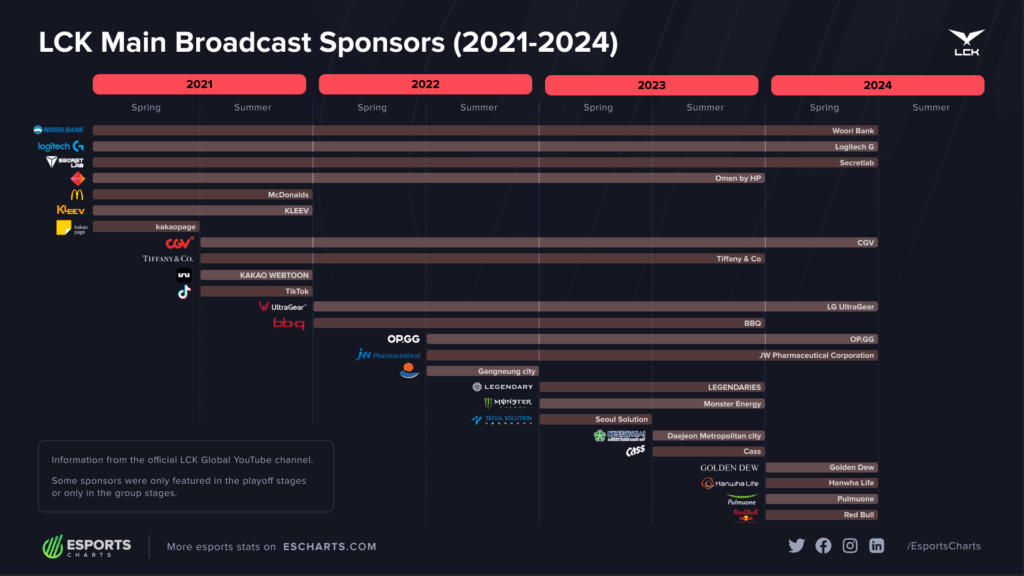
Taken together, these four layers show a market that’s matured well past logo-slapping: a dominant anchor sponsor, an expanding roster of non-endemic categories, brands that plug into local culture rather than just buying visibility, and hardware sponsors that blend into the competition itself. But all of this still happens around the game, on the broadcast layer. The next section looks at what happens when a publisher decides where the line actually gets drawn, starting with the strictest one in esports: Riot Games.
The Riot case: when the publisher protects its own playing field
Every sponsor mentioned in the last section, Woori Bank, JW Pharmaceutical, Hanwha Life, BBQ Chicken, LG, all live in the same place: around the game. On the broadcast, on the stage, on the hardware players use. None of them show up inside the actual match, on the map, in the client, or in the game itself. That’s not an accident. It’s a deliberate line drawn by the publisher, and understanding why Riot draws it that hard is essential to understanding what’s even possible to sell in League of Legends.
Riot’s policy is explicit and strict. The company’s official rules state that third parties may not place advertisements in Riot properties, which include the game itself, loading screens, and the Riot Client. That policy has only tightened over time: Riot updated its stance to clarify that third-party in-game advertising is no longer allowed at all, covering overlays, loading screens, and the client alike. For a company sitting on one of the most valuable esports audiences in the world, that’s a deliberate choice to leave money on the table rather than risk the player experience.
The one real exception makes the rule clearer, not weaker. In 2021, Riot partnered with Louis Vuitton to release limited-edition in-game character skins carrying the fashion brand’s logo, a decision that reportedly caused internal debate even at Riot. Crucially, that collaboration stayed purely cosmetic: a skin changes how a character looks, never how the game plays. No stat boost, no competitive edge, nothing that touches the actual match.
Even Riot’s closest thing to an in-game ad format was built to protect players first. Starting in 2020, Riot introduced Summoner’s Rift Arena Banners, real-world sponsor branding placed directly on the in-game map during official esports matches, with early partners including Mastercard and Alienware. But those banners are visible only to the audience watching the broadcast, not to the players competing in the match itself. Riot even framed the move explicitly around traditional sports, wanting the broadcast to carry the same kind of energy found in stadium sponsorship.
The Korean counter-example: PUBG and KartRider treat the ad as the product
Riot’s approach might make it tempting to assume this is just how esports works everywhere, or even how Korean gaming culture works in general. It isn’t. Cross over from League of Legends into PUBG or KartRider, both made by Korean studios, and the entire logic flips. What Riot treats as a line never to cross, these publishers treat as a core revenue stream.
KRAFTON, the studio behind PUBG, has leaned hard into automotive partnerships that go well beyond a logo on a loading screen. In 2025, PUBG: BATTLEGROUNDS partnered with luxury hypercar brand Bugatti to bring the Chiron into the game as fully playable in-game content, rolled out to PC and console live servers. The same broader strategy has since appeared in PUBG MOBILE through a collaboration with Kia, which introduced in-game vehicle skins based on the EV3, EV4, and PV5, alongside dedicated in-game events and an offline pop-up experience in Seoul. The collaboration reflects a broader shift in automotive marketing: partnerships with games increasingly go beyond a simple vehicle skin to combine playable content, community participation, and offline experiences, targeting gamers and the young consumers automakers increasingly want to reach.
PUBG has pushed the same logic into music. A collaboration with K-pop group aespa recreated a full concert stage on the game’s Miramar map as a dedicated “collab world,” complete with character skins modeled on the group’s members, exclusive emotes, and the game’s lobby music replaced with their songs. The same treatment applied to BLACKPINK: each member got a dedicated skin, and the group’s visual theme was applied throughout the game, extending into offline content as well. This isn’t a banner ad. It’s the brand becoming a piece of the game world itself, for as long as the event runs.
This isn’t about Korean publishers being more permissive as a cultural matter, it comes down to business model. Riot’s competitive titles depend on players trusting every match is a fair fight, so anything that could compromise that, or even just clutter the screen during ranked play, stays off-limits. PUBG and KartRider are built on cosmetic monetization by design, so a branded car or K-pop skin is simply inventory in the same shop players already spend in.
What this means for esports marketing at large: a reading grid for brands
Pull back from the individual examples, and a clear pattern emerges. What a brand can do in Korean esports depends less on budget and more on which game, and which publisher, sits behind it.
League of Legends and Valorant keep sponsorship almost entirely on the broadcast layer: logos, banners players never see, occasional cosmetic-only skins. The game itself stays untouched, the money moves around it, the way Woori Bank anchors LCK without ever appearing inside a match. PUBG and KartRider go the other way, folding branded content directly into the game world, playable cars, branded loot crates, K-pop collab maps, treating the brand as just another piece of content players choose to buy.
Three levers stand out as practical starting points, each suited to a different goal and budget.
- Player-as-icon. Attaching a brand to a figure like Faker buys reach and cultural relevance independent of any in-game inventory, proof being a campaign like the Google Play collaboration, built entirely outside League of Legends itself.
- Broadcast sponsorship. Buying visibility around a league, the way Woori Bank anchors LCK, is the most accessible entry point: a media buy against an established audience, no publisher negotiation required.
- Product integration. Getting a brand physically into the game, the way Kia sits inside PUBG MOBILE, is the deepest option, turning the ad into something players actively use and show off. It only exists where the publisher’s business model allows it.
Korean esports isn’t one market, it’s a set of ecosystems, each governed by a different publisher’s rules about what’s for sale. The real starting point for any brand strategy is understanding which publisher you’re dealing with, and what they’ll actually let you buy.